Mud Songs Praise
FORREST GANDER
Poet, translator, essayist, and novelist
Patricio Ferrari’s remarkable art of translanguaging—long normalized in Indian multilingual life—reflects a non-essentialist understanding of language and opens a frontier in poetry. To read him is to be drawn into confluence, a slipstream of creative, interactive linguistic registers. Like the Delphic Oracle, Ferrari’s Mud Songs speaks in a soft excitation of currents, an interstitial song. The poems are scored, sometimes literally, for deep emotional tenderness; returning themes concern maternity, motherland, mother tongue. And yet in Mud Songs, Ferrari finds a lyric voice for poetry beyond the authority of any nation, dictionary, or academy.
Applying his plural linguistic competence to a novel poetics, Ferrari doesn’t simply code-switch. Instead, he draws from one integrated linguistic repertoire in which permeable boundaries between languages allow for an abundance of meanings—sonic, visual, semantic—to arise through context and resonance. Hybridity becomes the site of agency.
MARTIN CORLESS-SMITH
Poet, literary translator, essayist, and painter
There is a tidal strength to Mud Songs, an inexorable motion and accrual of words and meaning like a sedimentary layering; history is a physical phenomenon: mud, mudder, madre, matter, mother, mother-tongue, the material of Ferrari’s linguistic birth in the muddy language mess of the Argentinian Delta. More than just a personal excavation of etymological and familial roots, Mud Songs is a revelation of history as language, and language as geography, of maps and matter: a polyglot son’s ever-shifting chanty about a life, a swell and ebb and about loss and change; it is a romance of Romance languages, a journal of journeying, and altogether a gathering anthematic love song to love and song.
MÓNICA DE LA TORRE
Poet, literary translator, and academic
“Self is a long arrival,” writes Patricio Ferrari in this ode to language’s boundless plasticity and the loving entangoment of his own and his native Buenos Aires’s many languages. While he was writing the translingual poems in the collection, he was also committed to finding the English register in which to voice Fernando Pessoa’s multifarious oeuvre as well as Alejandra Pizarnik’s French-language poems. In the delirious process of completing these extraordinary feats, he proved he too contained multitudes. This is only the first book of a trilogy—I marvel at what might come next.
PÁDRAIG Ó TUAMA
Poet, theologian, mediator, and broadcaster
Patricio Ferrari is a poet of language, form, meaning and music. His Mud Songs sing of our origins, our materiality, our musical aspirations, and our bewilderments. “Lighthouse of we” pronounces at the end of Terra, and notably the “we” is not just the living “Accents are / waves / curling / from the past” we hear, and the songs of the dead sing through our tongues. Here is a master of translation, languages inventing forms and webbed meanings. This collection is an invitation into clarity; rather, it is a welcome to the muddy ground of our evolving languages and the common—and uncommon—land between us.
COLE SWENSEN
Poet, translator, editor, and copywriter
Given that he literally grew up in a language school, it’s not surprising that Ferrari is fluent in several languages, or that he puts language, in all its fluidity and ubiquity, at the center of this beautifully hybrid text. Playing one tongue off another, he creates a music that resonates beyond any single linguistic system and emphasizes the eternal metamorphosis at the heart of all language—slipping from mouth to mouth across continents and eras, the act of human expression rises again, triumphant.
CRISTINA PIÑA
Poet and literary scholar
Este libro excelente y originalísimo escrito por Patricio Ferrari revela un profundo dominio de las tres lenguas que utiliza en él —italiano, inglés y castellano—. No es sólo que se maneje perfectamente bien en ellas, sino que juega con las palabras, transformándolas de manera profundamente creativa y capturando así nuevas e insospechadas significaciones.
Este deslumbrante dominio de las lenguas atrapa al lector, quien, además, se descubre jugando él mismo con la dimensión lingüística tal como lo hace el autor. Esto significa que a aquel se le confiere un papel activo que no es fácil de encontrar en la poesía actual.
Pero este manejo brillante de las lenguas no es sólo un rasgo predominante de este libro, sino que a través de él se alcanza una forma sumamente personal de hablar sobre los diferentes temas que abarca el poemario.
Así nos encontramos con una constante interrogación sobre la figura materna, que aparece no sólo rodeada de esas interrogaciones, sino que se subraya su peso en la vida interior del autor.
Pero también hay una revisión de los lugares paradigmáticos en la historia del sujeto poético. Así recorre diferentes lugares de Buenos Aires significativamente para él o para otros escritores y pintores argentinos de singular importancia. De tal manera aparecen Jorge Luis Borges, Alejandra Pizarnik y Benito Quinquela Martín, entre otros. Y esos poemas también muestran —como ocurre con todos los otros incluidos en este libro— un acercamiento lúdico a las palabras.
Esta variedad, tanto en el lenguaje como en los temas abordados, muestra la singular riqueza de Mud Songs, una riqueza que sin duda atrapará al lector en este libro inteligente y personal.
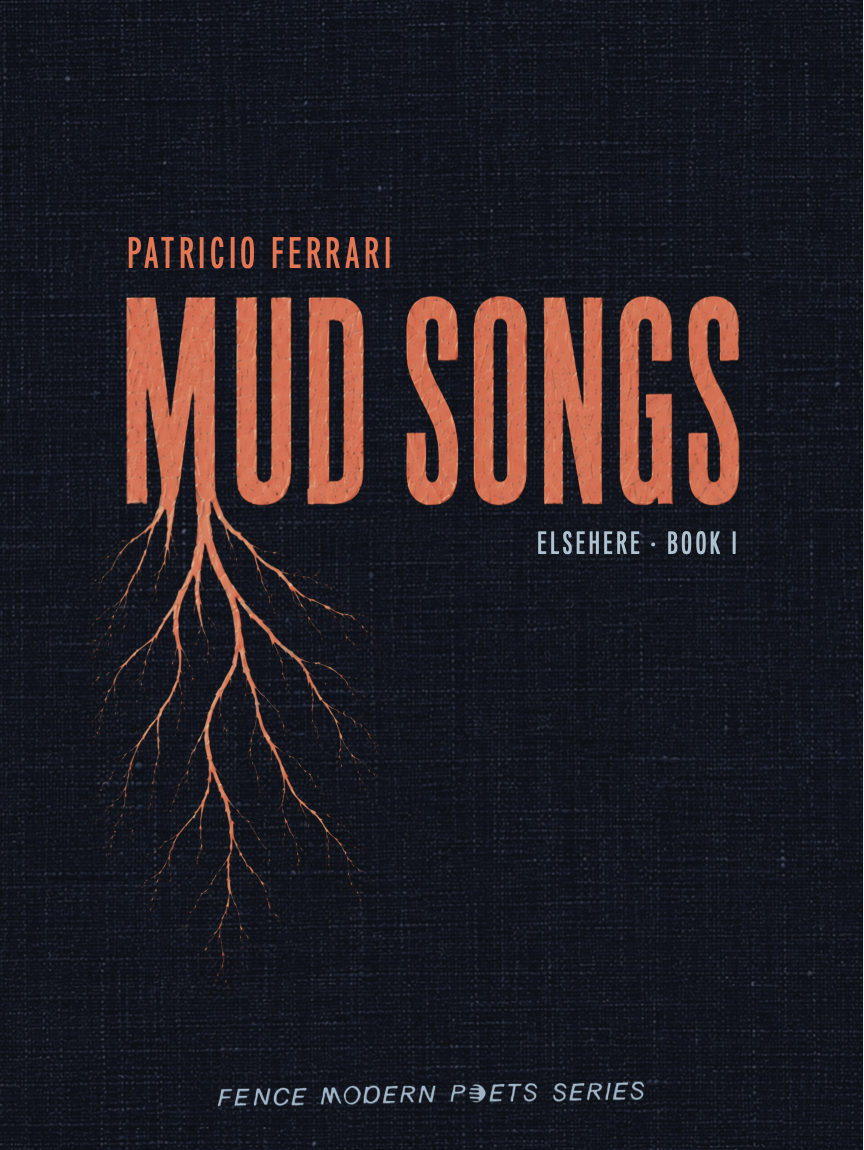
Mud Songs: Elsehere Book I by Patricio Ferrari,
published by Fence Books, November 24, 2026